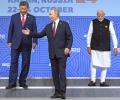
Russian Foreign Minister Sergey Lavrov alleged that NATO is blatantly trying to lure India into anti-China intrigues.

Prime Minister Narendra Modi and Chinese President Xi Jinping are set to meet in Tianjin on Sunday, their first in about 10 months, for wide-ranging talks aimed at improving relations.

The third BRIC summit in Sanya, China, on Thursday will have a new member: South Africa.

This could become tricky territory for India, given its basically adversarial relationship with China, its moves to block imports and investment from that country, and to deny market access for Chinese technologies, observes T N Ninan.

"We will examine the latest developments and make a determination about our future engagement with BRICS," Baloch said.

After visiting two Central Asian countries, Prime Minister Narendra Modi arrived in Ufa on Wednesday on a three-day trip during which he will attend the BRICS and Shanghai Cooperation Organisation summits.

India emerged reasonably well from 2025. But now, the oil shock and war-related supply disruptions have again driven funds out of India and significantly weakened the rupee, points out Ajay Chhibber.
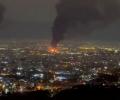
To be sure, Trump is furious, as the trajectory of the war is in a state of Zugzwang, as chess players call it. Trump and Netanyahu stare at two choices -- retreat in humiliation and concede Tehran's demands -- recognition of its rights, reparations, and binding security guarantees -- or perish in a quagmire, points out Ambassador M K Bhadrakumar.

'Prime minister is expected to hold some bilateral meetings on the sidelines of the SCO summit.'

Vietnam is an emerging regional power and a closer relationship with Hanoi is closely aligned with Prime Minister Narendra Modi's Act East Policy, points out Dr Rajaram Panda.
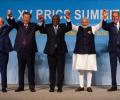
'Victims of terrorism do not sit together with its perpetrators to discuss terrorism.'

President Putin and Prime Minister Modi greeted each other with a warm hug, after which they walked towards the stage for a family photo of the SCO members.

We know in our heart that speaking the truth on this stupid Iran war will anger Trump and so we look the other way because if we look him in the eye the bully will straighten us out, asserts Aakar Patel.

The Congress and AAP said the logo looks like the party symbol of the Bharatiya Janata Party.

Prime Minister Narendra Modi and Chinese President Xi Jinping will hold bilateral talks on Wednesday on the margins of the Brazil, Russia, India, China, South Africa (BRICS) summit in Russia, in their first structured meeting since the eastern Ladakh border row erupted in May 2020.

NSA Ajit Doval has indicated that dates for Russian President Vladimir Putin's visit to India are being worked out during his meetings in Moscow. Discussions also covered bilateral energy and defence cooperation, amidst ongoing concerns over India's procurement of Russian crude oil.
Dar also said Pakistan views Russia as an important player in the West, South and Central Asia, and strengthening mutually beneficial cooperation with Russia remains an important priority for Pakistan's foreign policy.

Prime Minister Narendra D Modi jettisoned his usual black bandh gala for an elegant deep blue woolen coat for the dinner Russian President Vladimir Putin hosted for leaders attending the BRICS Summit in Kazan on Tuesday, October 22, 2024, evening.

India and China will resume direct flight services by the end of this month after a five-year gap, signaling an effort to rebuild ties strained by the border standoff in eastern Ladakh.
Rediff.com's Nikhil Lakshman, who is travelling with Prime Minister Manmohan Singh to the BRICS Summit in the Chinese town of Sanya, reports that the next BRICS Summit will be held in India in 2012 even as the five BRICS nations pledged to jointly work towards peaceful transformation of the world order.

Argentina, Egypt, Ethiopia, Iran, Saudi Arabia and the United Arab Emirates have been invited to join the grouping.

Prime Minister Narendra Modi has left from Delhi for Brazil to attend the five-nation Brazil, Russia, India, China and South Africa (BRICS) summit slated to be held for two days, starting Monday. Here is his statement ahead of the meet.

New Delhi 'will have to take a call which supply source suits us the best,' the finance minister said, pointing out that crude oil accounts for the bulk of India's foreign exchange spend.

The agreement was to disengage from remaining standoff sites along the Line of Actual Control (LAC), two days before a meeting between Chinese President Xi Jinping and Prime Minister Narendra Modi on the sidelines of the BRICS Summit.

Prime Minister Narendra Modi on Tuesday conveyed to Russian President Vladimir Putin that India stands ready to provide all possible cooperation towards ending the Russia-Ukraine conflict and that dialogue and diplomacy is the only way to bring peace to the region.

Prime Minister Narendra Modi is expected to visit Japan and China starting around August 29. The visit to China would be his first after the Ladakh border standoff.

'It is unrealistic to expect that security dilemmas and strategic distrust to disappear or even diminish any time soon,' says Rup Narayan Das.

Though he does not know what New Delhi is intending to do, Berlin would "welcome any engagement", he added.
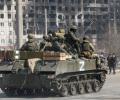
The Indian side is in "very close touch" with interlocutors in the foreign and defence ministries of Russia on the issue of Indians "who were, illegally or otherwise, contracted into fighting in the Russian Army", Misri said at a media briefing on Modi's visit to Russia for the BRICS Summit.

In August, the top BRICS leaders at the grouping's summit in Johannesburg approved a proposal to admit six countries, including Argentina, into the bloc with effect from January 1.
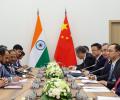
According to informed sources, Doval will arrive in Beijing on Tuesday to attend the crucial talks, which were expected to provide a way forward for the two countries to normalise the relations.
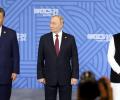
China has expressed its support for Russia's initiative to revive the Russia-India-China (RIC) troika, emphasizing its importance for regional and global security and stability.

'Modi's a great leader... But I don't understand why he's getting into bed with Putin and Xi Jinping...'

Russian President Vladimir Putin on Tuesday thanked Prime Minister Narendra Modi for trying to help find a peaceful solution to the Ukraine crisis.

The members resolved to foster a global economic governance architecture that is more effective and reflective of current global economic landscape
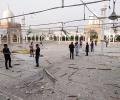
Chinese Foreign Minister Wang Yi stated that China mediated tensions between India and Pakistan, a claim disputed by India which maintains that the matter was resolved bilaterally.

India expects to see the bank established as soon as possible.

The joint declaration lists the BRICS nations' consensus on global economy, international financial issues and developmental affairs.
BRIC economies are currently worth around $11-12 trillion.

'I suspect that Bangladesh being given permission stuck in India's official craw, and this story was an attempt to balance the scales by giving the impression that a similar waiver had been given to India as well.'
